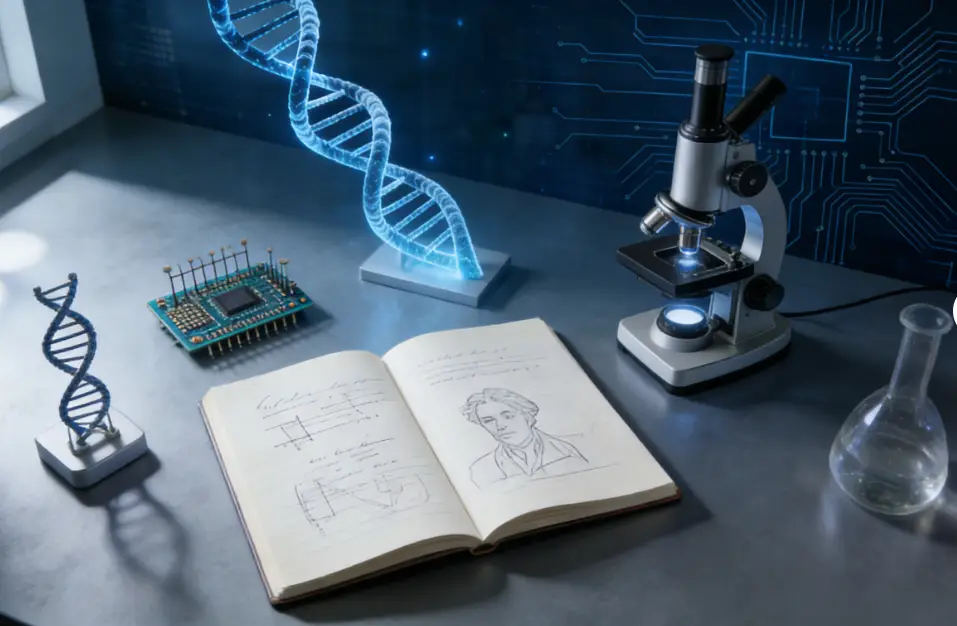
From Artificial Intelligence to Medicine, Energy, and the Future of Innovation
Science Is the Real Engine of Global Power
When people talk about wealth, power, or global influence, they often mention finance, politics, or corporations. Yet behind every trillion-dollar industry, every dominant company, and every modern convenience lies a quieter force: science and the inventors who transform knowledge into reality.
From artificial intelligence systems optimizing global logistics to medical technologies extending human life, scientific breakthroughs do far more than win awards or fill textbooks. They reshape economies, redefine careers, and create entirely new markets.
In today’s world, science is no longer confined to laboratories. It fuels startups, attracts massive investment, and determines which nations and companies lead the future. Understanding how science and inventors shape the modern world is not only intellectually fascinating—it is economically essential.
1. Why Science Continues to Drive Global Wealth
Science as an Economic Multiplier
Modern economies are no longer built primarily on natural resources or manual labor. Instead, they depend on intellectual capital, research, and technological innovation.
Scientific discoveries create:
- New industries (AI, biotech, renewable energy)
- Higher productivity across traditional sectors
- Long-term competitive advantages
For example:
- Semiconductor research enabled modern computing and cloud services
- Medical science created trillion-dollar healthcare and pharmaceutical markets
- Physics and materials science unlocked space technology and satellite communications
Each breakthrough becomes a foundation upon which entire ecosystems of businesses are built.
Innovation vs. Imitation
Countries and companies that invent tend to dominate those that merely adopt. Intellectual property, patents, and proprietary technologies allow inventors and investors to control markets rather than compete solely on price.
This is why:
- Governments heavily fund scientific research
- Corporations invest billions into R&D
- Venture capital flows toward science-driven startups
Science is not an expense—it is a strategic asset.
2. Inventors Who Changed Entire Industries (Not Just History Books)
The Shift from Individual Genius to System Builders
The popular image of inventors often focuses on lone geniuses. While individuals still matter, modern inventors increasingly operate within teams, institutions, and innovation ecosystems.
Today’s most influential inventors:
- Build platforms, not single products
- Combine multiple disciplines
- Work closely with engineers, investors, and policymakers
Industry-Level Impact
Rather than asking “What did they invent?”, a better question is:
“What industries exist because of their work?”
Examples include:
- Computer scientists whose algorithms power search engines, AI, and e-commerce
- Biomedical engineers whose devices enable modern surgery and diagnostics
- Energy researchers whose innovations redefine power generation
The true impact of inventors is measured not in patents alone, but in markets created and lives transformed.
3. Artificial Intelligence: Science Accelerating Science
AI as a Scientific Force Multiplier
Artificial intelligence is not just another technology—it is a tool that accelerates discovery across nearly every scientific field.
AI is now used to:
- Analyze massive datasets in physics and astronomy
- Model protein structures in biology
- Optimize chemical reactions in materials science
- Predict climate patterns with greater accuracy
This creates a feedback loop:
Science improves AI, and AI accelerates science.
The New Generation of AI Inventors
Modern AI inventors are often:
- Researchers with deep mathematical and computational backgrounds
- Engineers working at the intersection of theory and application
- Entrepreneurs turning models into scalable platforms
As AI becomes embedded in medicine, finance, manufacturing, and research itself, inventors in this space shape both technology and society.
4. Medical Science and the Inventors Extending Human Life
From Treatment to Prevention
Medical science has moved far beyond treating symptoms. Inventors today focus on:
- Early diagnosis
- Personalized medicine
- Minimally invasive technologies
Innovations in imaging, genomics, and data analysis allow doctors to detect diseases earlier and tailor treatments more precisely.
High-Impact Medical Technologies
Inventors in medical science have enabled:
- Robotic surgery systems
- Wearable health monitoring devices
- Advanced diagnostic imaging
- Gene therapies and regenerative medicine
Each innovation not only improves patient outcomes but also creates new healthcare markets and specialized professions.
5. Clean Energy and Climate Innovation: Science Under Pressure
The Urgency of Energy Innovation
Climate change has transformed clean energy from an environmental issue into an economic and geopolitical priority.
Scientific inventors are racing to:
- Improve solar and wind efficiency
- Develop advanced battery storage
- Create sustainable fuels
- Reduce industrial emissions
Energy Inventors as Market Makers
Energy innovation affects:
- Transportation
- Manufacturing
- Infrastructure
- National security
Inventors in this space are not only solving technical problems—they are reshaping how societies produce and consume power.
6. Science Is No Longer Isolated: The Rise of Corporate Research
Why Big Companies Invest in Science
Major corporations now operate research labs that rival universities. Their goals include:
- Long-term innovation pipelines
- Competitive technological advantages
- Talent acquisition
Companies in technology, pharmaceuticals, and energy depend on scientific research to remain relevant.
Collaboration Between Academia and Industry
Modern inventors often move between:
- Universities
- Corporate research labs
- Startups
This cross-pollination speeds up commercialization and ensures that scientific breakthroughs reach real-world applications faster than ever before.
7. The Highest-Paying Science Careers Today
Science as a Career Investment
Scientific training is increasingly linked to high-income, future-proof careers.
Some of the most lucrative roles include:
- Artificial Intelligence Scientist
- Data Scientist
- Biomedical Engineer
- Materials Scientist
- Energy Systems Engineer
These roles combine deep technical knowledge with problem-solving skills that are difficult to automate or outsource.
Lifelong Learning in Science
Unlike many traditional careers, science-based professions evolve continuously. Successful inventors and researchers commit to:
- Continuous education
- Cross-disciplinary learning
- Adapting to new tools and methods
This adaptability is one reason science careers remain resilient in uncertain economic times.
8. From Laboratory to Billion-Dollar Startup
How Science Becomes Business
Many groundbreaking startups originate from scientific research. The path typically involves:
- Fundamental discovery
- Proof of concept
- Commercial application
- Scaling with investment
Inventors who understand both science and business are uniquely positioned to succeed.
The Role of Venture Capital
Investors increasingly seek science-driven startups because:
- Deep technology creates high barriers to entry
- Intellectual property protects long-term value
- Breakthroughs can redefine markets
As a result, inventors today often become entrepreneurs, shaping both innovation and economic growth.
9. The Future of Science and Invention
Emerging Frontiers
The next wave of inventors will likely focus on:
- AI-enhanced scientific research
- Space exploration and commercialization
- Human-machine interfaces
- Advanced materials and nanotechnology
- Climate resilience technologies
Who Will Shape Tomorrow?
Future inventors will not be defined solely by intelligence, but by:
- Interdisciplinary thinking
- Ethical awareness
- Global collaboration
Science is becoming more connected, more powerful, and more influential than ever before.
Why Science and Inventors Matter More Than Ever
Science is not just about discovering how the world works—it is about deciding how the world will work next.
Inventors transform ideas into tools, industries, and opportunities. They influence:
- Economic growth
- Public health
- Environmental sustainability
- Global competitiveness
In a rapidly changing world, science remains the most reliable engine of progress. Those who invest in understanding, supporting, and advancing scientific innovation will help define the future—both technologically and economically.