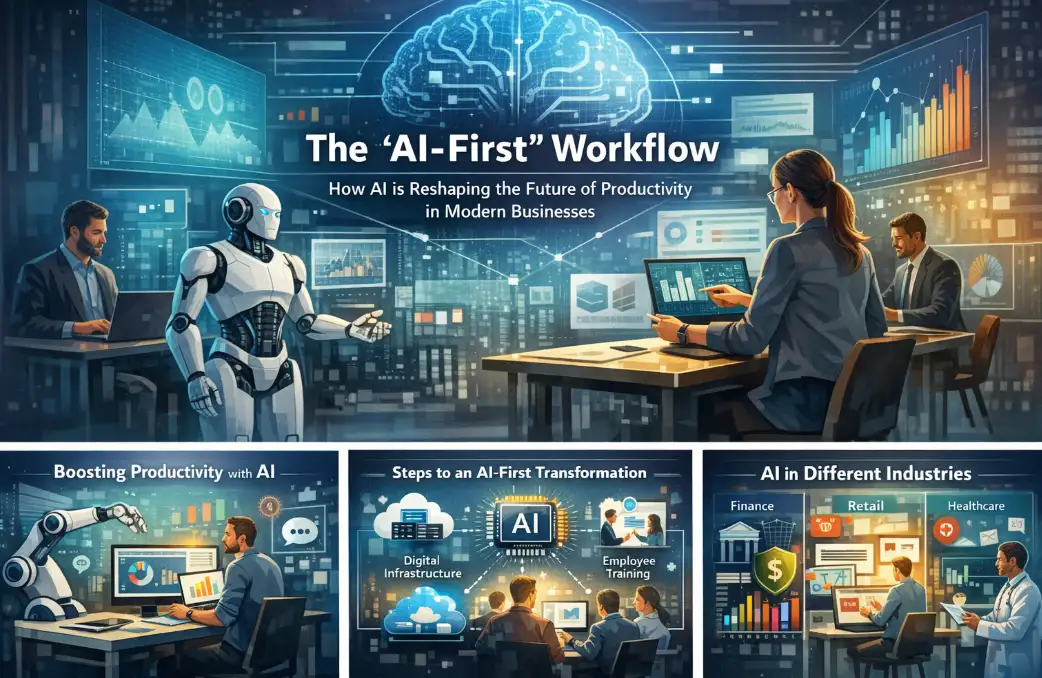
As artificial intelligence (AI) technology rapidly evolves, many businesses are no longer treating it merely as an auxiliary tool but have integrated it into the core of their workflows. This transformation is referred to as the “AI-First” workflow. Through the “AI-First” model, businesses are not only able to increase productivity but also gain a competitive edge in an increasingly challenging market.
In this article, we will explore the concept of the “AI-First” workflow, the steps to implement it, and how it is fundamentally changing the way modern businesses operate. We will also provide real-world examples to help businesses understand how to effectively apply this model and reveal future trends in AI technology.
1. What is the “AI-First” Workflow?
The “AI-First” workflow refers to a working model in which AI technologies transition from being supplementary tools to becoming the driving force behind business processes. In this model, AI is applied not only for task automation and data analysis but also extensively in decision-making, innovation, and workflow optimization.
Unlike traditional human-centered workflows, the “AI-First” model integrates machine learning, natural language processing, predictive analytics, and other technologies into daily operations. This enables businesses to accomplish more tasks in less time and make more accurate decisions. For example, AI can analyze vast amounts of data to predict market trends and help companies adjust their strategies—doing so based on machine-driven insights rather than human experience.
2. How Does “AI-First” Affect Productivity in Modern Businesses?
The widespread adoption of AI technology has led to a significant boost in productivity across industries. Here are some specific impacts:
- Task Automation and Workflow Simplification: Businesses can use AI to reduce repetitive tasks, allowing more time and resources to be devoted to creative and strategic tasks. For example, AI can automate data entry and report generation, significantly enhancing efficiency.
- Optimized Customer Service: Through chatbots, intelligent customer service systems, and personalized recommendations, AI can quickly respond to customer needs and improve customer satisfaction. This not only optimizes the customer experience but also alleviates the burden on human customer service teams.
- Intelligent Decision Support: AI can extract valuable insights from large volumes of historical data, providing real-time decision support for businesses. Whether it’s inventory management, product pricing, or marketing strategies, AI helps companies make more scientific and precise judgments.
For example, e-commerce giant Amazon uses AI to analyze customer purchasing behavior and recommend personalized products, which has significantly boosted conversion rates.
3. Steps for Businesses to Implement an “AI-First” Transformation
While the potential of the “AI-First” model is immense, businesses face challenges when transitioning. Below are the key steps to successfully implement this transformation:
- Building Digital Infrastructure: Before implementing AI, businesses need a strong digital infrastructure, including cloud computing platforms, big data processing capabilities, and more. This foundation is essential for the smooth operation of AI systems.
- Choosing the Right AI Tools: Businesses must select AI tools that match their specific needs. For example, financial institutions may focus on data analysis and risk management tools, while retail businesses may prioritize personalized recommendations and inventory optimization tools.
- Employee Training and Cultural Shift: Implementing AI is not just a technological change; it requires a shift in company culture. Employees must be trained to collaborate effectively with AI. Moreover, businesses need to foster an open culture that encourages innovation and embraces new technologies.
- Data Security and Privacy Protection: Data is the core asset in AI applications. Businesses must ensure that data security and compliance are top priorities, particularly when handling sensitive information. Implementing advanced encryption techniques and adhering to regulatory standards is crucial.
4. Challenges and Solutions in an “AI-First” Workflow
While the “AI-First” model offers many benefits, businesses face several challenges during implementation:
- Technology Integration and Compatibility: The selection and integration of AI tools often require complex technical support, and companies may encounter compatibility issues with different systems. The solution is to choose AI tools with open APIs that can be seamlessly integrated with existing systems.
- Employee Resistance: Many employees may have reservations about the use of AI, fearing that it might replace their jobs. Businesses should address this by offering training and transparent communication, helping employees understand the value of AI and how it can be a powerful tool to support them.
- Data Privacy and Compliance: The effectiveness of AI relies heavily on large volumes of data, making data privacy and compliance crucial. Businesses can address these issues by implementing data protection measures that comply with international standards like GDPR.
5. Industry-Specific Applications of the AI-First Workflow
The “AI-First” workflow has already been successfully applied in various industries:
- Finance: AI is helping financial institutions predict risks, detect fraud, and enhance customer service. For example, JPMorgan Chase uses AI to analyze market trends and provide investment recommendations to clients.
- Retail: AI enables businesses to recommend personalized products based on consumer behavior and optimize inventory management and supply chain processes. Retail giants like Walmart and Target are using AI to analyze customer behavior and boost sales.
- Healthcare: AI’s application in healthcare is expanding, particularly in disease prediction and diagnostics. AI can analyze medical imaging data, helping doctors detect abnormalities at earlier stages.
6. Future Trends in the AI-First Workflow
As technology continues to evolve, the future of the “AI-First” workflow is even more exciting. Here are some future trends:
- Reinforcement Learning and Adaptive AI: The next generation of AI will not just follow fixed rules; it will learn and adapt in real time, making more flexible and personalized decisions.
- Generative AI Applications: Generative AI (such as GPT-4) will further revolutionize creative industries, enabling the generation of high-quality content from advertisements to movie scripts.
- Cross-Industry AI Collaboration: AI systems across different sectors will work more collaboratively, forming cross-industry AI networks. For instance, AI in finance and healthcare could converge to create new business models and innovations.
Conclusion
The “AI-First” workflow is not just a future trend; it is already a key enabler for growth and innovation in many leading businesses. By embracing AI, companies can enhance productivity, optimize customer experiences, and gain a competitive advantage in the market. For companies that have yet to implement AI, beginning the transformation process now will set the stage for future success. With the right approach to AI, businesses can unlock its full potential and build a foundation for long-term success.