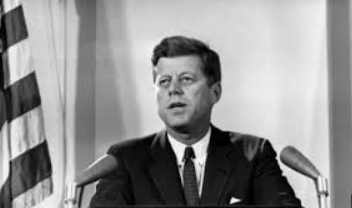
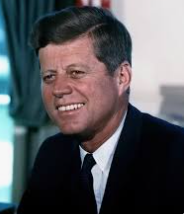
John F. Kennedy was the second youngest president elected in U.S. history. He experienced one of the most critical moments of the Cold War—the Cuban Missile Crisis—and sought to affirm America’s belief in basic human rights through civil rights legislation and poverty reduction. Kennedy was assassinated on November 22, 1963, shocking both the United States and the world.
Early Life
John F. Kennedy was born in May 1917 into a prominent political family. His father, Joseph Kennedy, was an influential member of the Democratic Party and encouraged John’s political ambitions after World War II.
Kennedy graduated from Harvard University after completing a thesis titled “Appeasement in Munich,” which was later adapted into a best-selling book, Why England Slept (1940).
Before the U.S. entered World War II, Kennedy joined the Navy and served throughout the Pacific theater. In August 1943, his patrol boat was struck by a Japanese destroyer. Kennedy was awarded for extraordinary heroism in rescuing his crew and also received the Purple Heart later in the war. He remained humble about his actions, noting that it was partly the result of a failed military operation.
In 1946, he won a seat in the U.S. House of Representatives representing Boston and was elected U.S. Senator in 1952, defeating the incumbent Republican.
In 1953, Kennedy married Jacqueline Lee Bouvier. In 1957, he won the Pulitzer Prize for Biography with his book Profiles in Courage, which highlighted U.S. senators who stood up for their beliefs.
By 1956, he was nearly chosen as Adlai Stevenson’s running mate for vice president, which increased his national recognition. In 1960, he became the Democratic Party’s presidential nominee.
Presidency
Election Victory
In 1960, Kennedy narrowly defeated Republican Richard Nixon in a highly competitive election. Television played a major role, and Kennedy’s calm, confident appearance on screen helped him win over voters.
He was the first Catholic elected president, which was a significant issue at the time. To gain trust among Protestant voters, he made it clear that he would not be influenced by the Vatican
Inaugural Address
At his inauguration, Kennedy delivered a memorable speech:
“Ask not what your country can do for you—ask what you can do for your country.”
He also emphasized internationalism:
“Let every nation know, whether it wishes us well or ill, that we shall pay any price, bear any burden…to assure the survival and the success of liberty.”
Early Initiatives
Kennedy established the Peace Corps, a government-run volunteer program sending young Americans to developing countries, aiming to improve foreign perceptions of the U.S. and foster global solidarity.
Bay of Pigs Invasion
In 1961, under CIA pressure, Kennedy reluctantly approved the Bay of Pigs invasion, led by Cuban exiles with minimal U.S. support. The operation failed, but Kennedy took responsibility, showing leadership and accountability.
Cuban Missile Crisis
In 1962, the Soviet Union deployed missiles in Cuba, bringing the world to the brink of nuclear war. Military leaders urged a pre-emptive strike, but Kennedy chose a cautious diplomatic approach. After tense negotiations:
- The Soviets removed missiles from Cuba
- The U.S. promised not to invade Cuba
- Secretly, the U.S. removed missiles from Turkey
Kennedy’s handling was widely praised and led to the establishment of the Moscow–Washington hotline, easing Cold War tensions.
Vietnam Policy
During his brief presidency, Kennedy increased U.S. involvement in Vietnam, sending 16,000 military advisors. Secretary of Defense Robert McNamara later said Kennedy considered withdrawing in 1963 and believed U.S. involvement could have ended if Kennedy survived.
Civil Rights
Kennedy supported the civil rights movement but faced pressure from Southern white voters. He backed voter registration efforts, appointed African Americans to government positions, and nominated Thurgood Marshall to the U.S. Court of Appeals.
In May 1963, the shocking brutality of Birmingham police against protestors prompted Kennedy to take stronger action. On June 11, he addressed the nation on television, stressing the need for civil rights legislation:
“The core issue is whether all Americans are to enjoy equal rights and equal opportunities…A hundred years after President Lincoln freed the slaves, their descendants still have not fully gained their freedom.”
“Ich bin ein Berliner” Speech
In June 1963, Kennedy addressed up to 450,000 people in West Berlin, condemning the Berlin Wall and East German communism, famously declaring:
“All free men, wherever they may live, are citizens of Berlin. Therefore, as a free man, I take pride in the words: Ich bin ein Berliner!”
The speech was warmly received and became an iconic moment in the Cold War.
Assassination
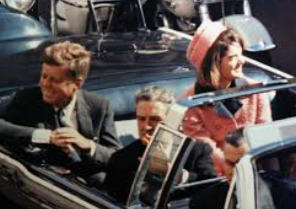
On November 22, 1963, Kennedy was assassinated in Dallas. Lee Harvey Oswald was arrested but killed by Jack Ruby before trial. The assassination sparked widespread conspiracy theories and left a political vacuum in the U.S.
Nevertheless, Vice President Lyndon B. Johnson succeeded him, passing civil rights legislation and social welfare programs, fulfilling many of Kennedy’s unfinished goals. Kennedy’s brother, Robert F. Kennedy, was also assassinated in 1968 while seeking the Democratic presidential nomination.