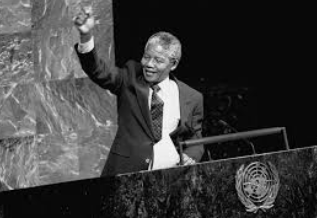
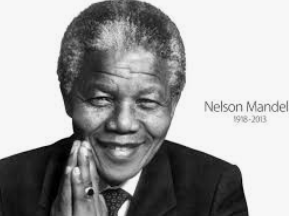
Nelson Mandela (1918–2013) was a legendary South African political leader. He was imprisoned for over 20 years for opposing apartheid and was released in 1990. In 1994, he became the first president of a democratic South Africa. Mandela is celebrated not only for his political achievements but also for his ability to forgive and unite a divided nation, earning him the title of the architect of the “Rainbow Nation.”
“I have learned that courage is not the absence of fear — it’s inspiring others to move beyond it. The brave man is not he who does not feel afraid, but he who conquers that fear.”
— Nelson Mandela
Early Life and Education

Nelson Mandela was born on July 18, 1918, in Transkei, South Africa, the son of a local tribal chief of the Thembu people. Unlike his father, Mandela received a full formal education, attending the University College of Fort Hare and later the University of the Witwatersrand, where he earned a law degree in 1942.
During university, Mandela became increasingly aware of racial inequalities faced by non-white South Africans. In 1943, he joined the African National Congress (ANC) and actively engaged in the struggle against apartheid.
Early Political Career and Armed Resistance
Mandela became one of the few qualified black lawyers in South Africa and quickly rose through the ranks of the ANC. In 1956, he and other ANC members were arrested for treason but were acquitted in 1961. As the ANC was banned, Mandela advocated for armed resistance, leading to the formation of the guerrilla organization Umkhonto we Sizwe.
In 1963, Mandela was arrested again and convicted of plotting to overthrow the government. The trial drew international attention.
“We believe that South Africa belongs to all who live in it, black and white. We do not want a racial war, and we have tried to avoid it until the very last moment.”
— Nelson Mandela, Supreme Court of South Africa, Pretoria, April 20, 1964
Imprisonment: The Robben Island Years

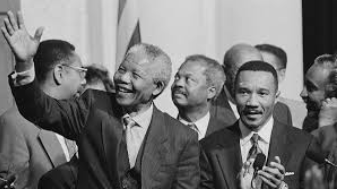
From 1964 to 1981, Mandela was imprisoned on Robben Island near Cape Town. Life in prison was harsh, but Mandela maintained strict discipline, studying and exercising daily, and built deep friendships with fellow political prisoners and even some guards. He saw himself fighting apartheid, not individual white people.
Mandela’s imprisonment made him an international symbol of the anti-apartheid struggle. Global pressure and sanctions against South Africa grew, ultimately forcing the apartheid regime to negotiate with Mandela and the ANC.
Freedom and the Birth of Democratic South Africa

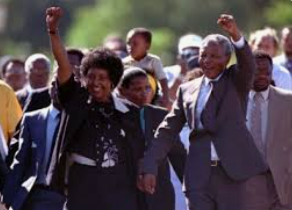
On February 11, 1990, Mandela was released, signaling the imminent end of apartheid. After lengthy negotiations, South Africa held its first fully democratic election in 1994. The ANC won 65% of the vote, and Mandela became the first president of the new South Africa.
“The time has come to heal the wounds of the past. The moment has come to bridge our divides. The time has come to build.”
— Nelson Mandela
As president, Mandela focused on reconciliation. Despite past suffering, he forgave his oppressors, earning the respect of all South Africans.
He played a key role in uniting the nation through sports, encouraging black South Africans to support the previously white-dominated rugby team, the Springboks, during the 1995 Rugby World Cup. In an iconic moment, Mandela wore the Springbok jersey and presented the trophy to the winning South African team.
Truth and Reconciliation Commission
Mandela established the Truth and Reconciliation Commission to investigate apartheid-era crimes while emphasizing forgiveness and national unity. Chaired by Desmond Tutu, the commission helped South Africa look toward a shared future.
Later Life and Family
Mandela retired in 1999, succeeded by Thabo Mbeki. In his later years, declining health limited his public activities, though he spoke out on global issues, such as criticizing the 2003 Iraq War and advocating for HIV/AIDS awareness in South Africa.
He married three times and had six children and 17 grandchildren:
- Evelyn Ntoko Mase
- Winnie Madikizela-Mandela
- Graça Machel
Mandela was affectionately known by his Xhosa clan name, Madiba.
Death and Legacy

Nelson Mandela passed away on December 5, 2013, at the age of 95, surrounded by family. President Barack Obama stated at his memorial:
“We will likely never see the likes of Nelson Mandela again. It is now up to us to carry on the example he set. He no longer belongs to us; he belongs to the ages.”
Mandela remains one of the most revered leaders of the 20th and 21st centuries. His forgiveness, wisdom, and pursuit of democracy continue to inspire the world.
References and Further Reading
- Nelson Mandela speeches (Supreme Court, April 20, 1964)
- Biographies and historical archives
Recommended Reading: Long Walk to Freedom by Nelson Mandela